Organizing home maintenance is not about finding the perfect app or the right spreadsheet. It is about building one reliable place where your history, reminders, and professionals all live together so nothing important gets lost.
Ask most homeowners where their maintenance information lives and the answer sounds something like this: some of it is in email, some is in a folder somewhere, the contractor's number is in my phone, and I think we still have the water heater manual. That is not a system. It works until the moment it doesn't, and by then something has usually already gone wrong.
Why scattered information creates real problems
When home maintenance is spread across multiple places, every decision requires a search. You need to know when the HVAC was last serviced — that's in an email from two years ago. You want to rehire the plumber who did great work — his number is saved without any context about what he actually fixed. You're trying to match a paint color — the can is long gone and you never wrote it down. The information exists somewhere, but it isn't accessible when you actually need it. Over time, scattered information doesn't just create inconvenience. It creates gaps in your home's history that affect decisions, contractor conversations, and your ability to catch problems before they become expensive.
What organized home maintenance actually looks like
Organized home maintenance is not about having perfect records from day one. It is about having one centralized place where three things live together: what has been done, who did it, and what needs to happen next. When those three elements are connected, you stop repeating searches, stop guessing at timelines, and stop losing good professionals to the fog of a busy year. The result is an organized home maintenance tracking system.
The four things every organized system needs
Most homeowners try to solve organization with a single tool, a spreadsheet, a folder, a notes app. The problem is that each of those handles one piece of the puzzle but not all of it. A complete home maintenance system needs four components working together to create a system of record.
The first is a project and task log. Every repair, upgrade, and maintenance task should be recorded with a completion date and basic notes. Not a novel — just enough to answer the question "when did we last do this?" a year from now.
The second is recurring maintenance reminders tied to real dates. Generic calendar alerts get ignored. Reminders that are set based on when you actually completed a task — not a preset schedule — are far more useful because they reflect the real state of your home rather than an assumption.
The third is a professional directory connected to your home. Not just saving trusted professionals in your phone, but a record of which pro did which work, when, and whether you would use them again. This is the detail that disappears fastest and costs the most to lose.
The fourth is a centralized location for documents. Warranties, inspection reports, receipts, and service records should live in one searchable place — not across three email accounts and a junk drawer.
Why this is harder to maintain than it sounds
Building a system is straightforward. Maintaining it is where most homeowners fall short. Not because they stop caring, but because updating a manual system requires consistent effort across months and years, and life does not cooperate with that kind of consistency. The system that works is the one that requires the least friction to keep current — ideally one that updates itself as part of the natural workflow of getting work done.
How homeowners are solving this today
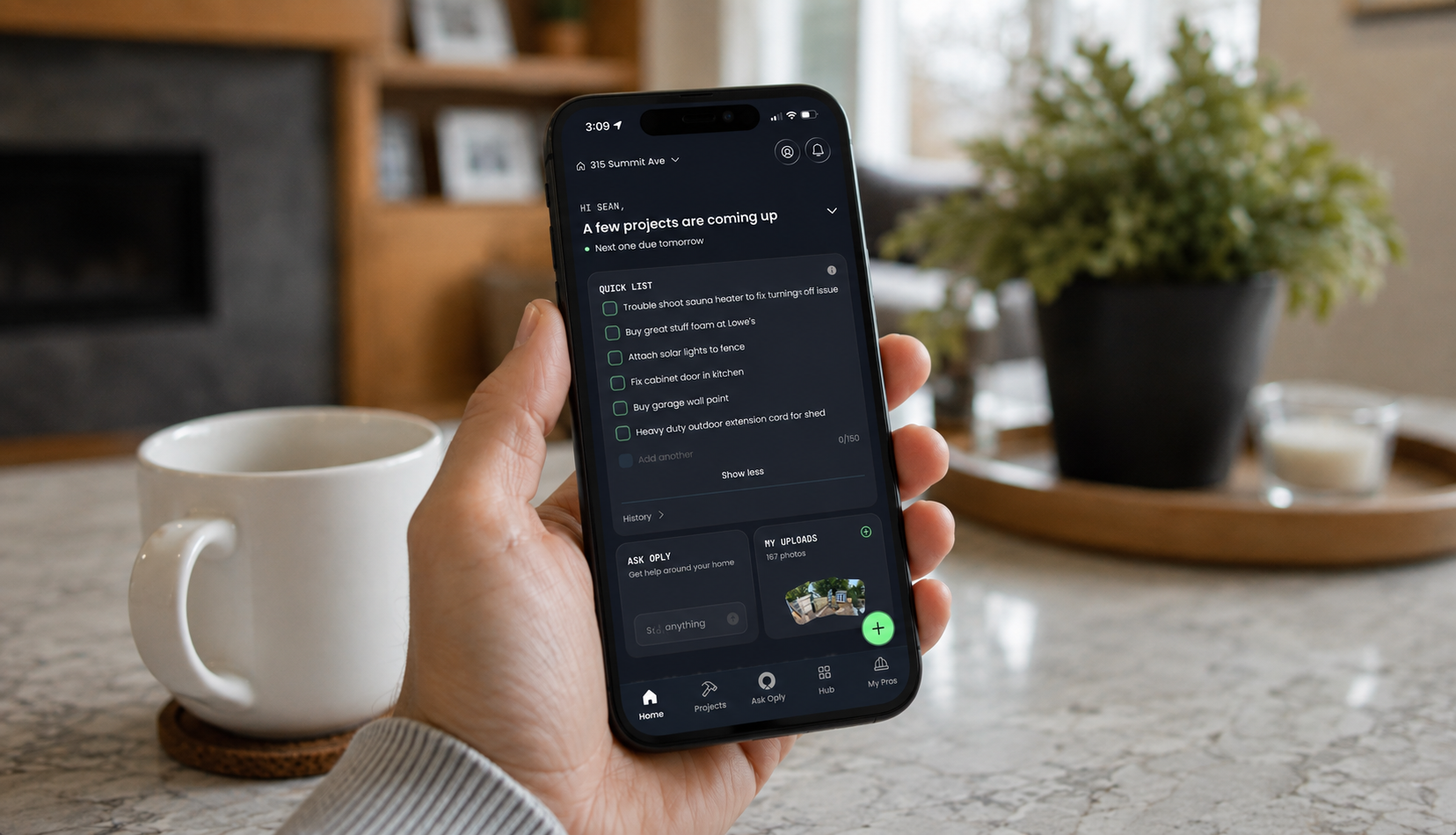
Some homeowners build their own systems using a combination of notes apps, shared folders, and spreadsheets, but most of the time spreadsheets fall short. Others use platforms like Oply, an AI-powered home maintenance platform, that bring task tracking, recurring reminders, professional history, and service records into a single organized home profile. The goal is not complexity — it is reducing the number of places you have to look when you need an answer about your home.
The long-term payoff
An organized home maintenance system pays off in ways that are hard to see in the first year but become very clear by year five. Decisions are faster. Contractor conversations are more informed. Resale preparation is less stressful. And the quiet, low-grade anxiety of not knowing what your home needs — or what it has already had done — disappears. Organization is not the end goal. Confidence is. And one organized system is how you get there.