Angi's CEO told shareholders in May 2026 that after 30 years focused on the homeowner's problem of finding a pro, the company is pivoting to solve the pro's core problem: winning work. The legacy homeowner platform is being frozen. The homeowner relationship is being left to LLMs and personal agents. That is a coherent business decision — and it leaves a specific gap that nobody in the category is filling.
Sometimes a company says the quiet part out loud.
In its Q1 2026 shareholder letter, Angi CEO Jeff Kip wrote: "We have spent 30 years focused primarily on the homeowner's problem of finding a pro. We are now going to shift our focus to solve the pro's core problem: winning work." PR Newswire
That sentence is worth reading slowly. Thirty years. The homeowner's problem. Shifting focus. Winning work.
He continued: "We are done optimizing an old machine; we are going to build the new one." PR Newswire
The old machine was built for homeowners. The new one is being built for contractors.
What Angi is actually building
The pivot is not vague. Angi described it in specific product terms.
The company is building what it calls the "Angi Pro Chief Revenue Officer" — an AI-driven system for contractors that includes job detail capture, automated responses, appointment booking, AI-generated quotes, and follow-up tools. The first agent is an AI front desk that makes and takes calls on behalf of pros.
Simultaneously, Angi announced a feature freeze on its legacy homeowner platform, the end of quarterly financial guidance, and a shift to flexible pricing for pros — per lead, per appointment booked, or per job won. Chicago Agent Magazine
Angi's stock fell more than 35 percent on the day of the announcement. Multiple securities law firms subsequently opened investigations into whether the company had misled investors. HousingWire
None of that changes the strategic logic of the move. Angi is betting that the homeowner discovery problem — finding a pro — will increasingly be solved by LLMs and personal agents, and that the durable business is on the pro side, helping contractors win more of the jobs that flow through the platform.
The numbers behind that bet are significant: $35 billion in annualized homeowner job value flows through the Angi platform, but only about $10 billion is completed by Angi pros. That $25 billion gap is what the pivot is designed to close.
Angi's logic is coherent
It is worth being fair about this. Angi's CEO did not say the company no longer cares about homeowners. He said helping pros win work better will ultimately produce better homeowner outcomes — faster response, more accurate quotes, better follow-through.
On the earnings call, Kip said: "When our pros get better results, our homeowners get better results. When customers get better results, the LLM wants their customers to go there." Scotsman Guide
That is a reasonable theory. A contractor with better tools responds faster. A homeowner with a faster response gets their job done. Transaction quality goes up. Angi captures more of the demand already on its platform.
It is a transaction optimization strategy. Make the moment of hiring faster, smoother, and more likely to convert.
That is a real and valuable thing to build.
It is also not what most homeowners actually need.
The transaction is not the hard part
Finding a pro is a problem. It is not the primary problem of homeownership.
The primary problem is everything that happens between transactions — and for years before and after any single job.
Knowing when the HVAC was last serviced. Knowing the age of the water heater before it fails. Having a record of who did what work and when. Being able to demonstrate maintenance history to an insurance adjuster when a claim is disputed. Understanding which systems are aging and need attention before they become emergencies.
Angi acknowledges that homeowner relationships will increasingly be mediated by LLMs and personal agents: "Consumers are gonna have personal agents more and more, and those personal agents are gonna be able to go out, perform tasks for them without them necessarily interfacing with, in their minds, a website." Scotsman Guide
That is correct. Personal agents will handle an increasing share of the homeowner discovery problem. They will answer "who should I call about my HVAC?" by pulling from Angi or whoever is best positioned on those platforms.
But before the agent can answer "who should I call," the homeowner needs to be asking the right question. And before that question can be answered well, the agent needs data about the specific home: how old the system is, when it was last serviced, what has already been done, what is genuinely urgent versus routine.
That data does not live in Angi. It does not live in any transaction marketplace. It lives in the home's own record — if the homeowner has one.
The layer nobody is building
The home services category has always been organized around the transaction. Find a pro. Get a quote. Book the job. Rate the experience.
That is the layer Angi optimizes. It is also the layer that LLMs will increasingly commoditize. Finding a pro is an information problem. Information problems are exactly what LLMs solve.
What LLMs cannot solve — at least not without data that does not currently exist in structured form — is the home intelligence problem. What does this specific house need? When did this specific system last get attention? What is the service history of this specific property?
That data has to be built. It does not exist in any marketplace database. It exists only if homeowners have been systematically tracking their own homes — which, as Angi's own International Homeowners Study found, nearly half are trying to do without any real system to support it.
According to Angi's 2026 International Homeowners Study, 49 percent of American homeowners take a proactive approach to home maintenance. The data does not measure how many of them have a documented record to prove it.
That is the gap. Not finding a pro. Not winning a job. The home's own memory — the record of what has been done, what is aging, what is coming, and what a specific household needs next.
What Oply is building
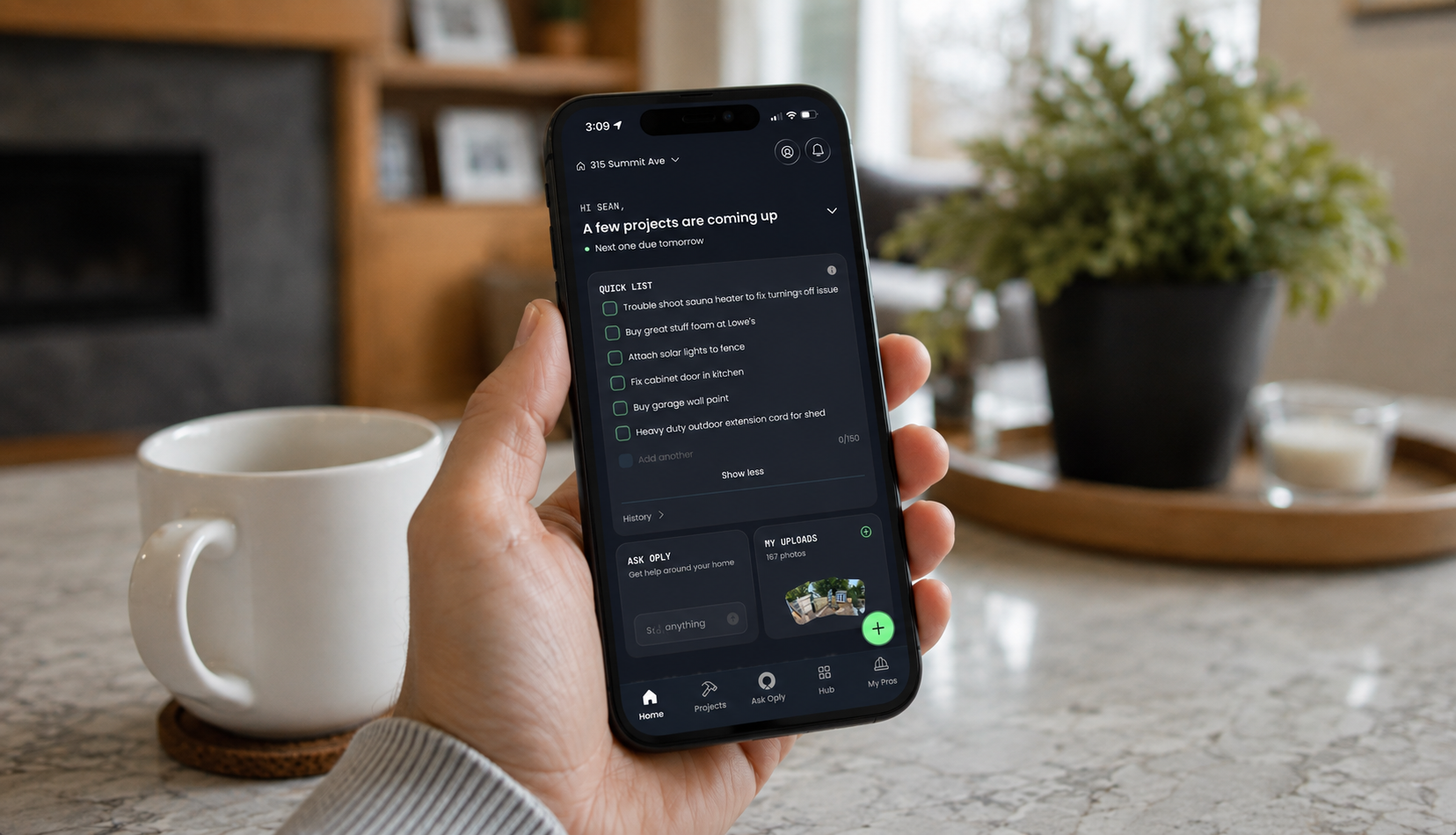
Oply is an AI-powered home maintenance platform. Not a marketplace. Not a lead generation tool. Not a contractor CRM.
A system of record for the home itself.
When a homeowner logs their HVAC service date, saves the contractor who did the work, sets a reminder for the next filter change, and builds a maintenance history over years of ownership, they are creating something that no transaction marketplace generates: a home intelligence layer that gets more valuable the longer it is used.
That layer is what personal agents will need to answer "what does my house need next" with authority rather than generality. It is what insurance adjusters ask for when a claim is filed. It is what buyers want to see when a home is sold. It is what homeowners need to shift from reacting when something breaks to managing proactively over time.
Angi is building the tool that helps a contractor win a job. Oply is building the record that tells a homeowner what job needs to happen in the first place.
Those are different problems. They have always been different problems. The difference is that now the 30-year incumbent has said, plainly, which one it is choosing.
When the incumbent vacates a lane
When the largest, most established name in a category publicly shifts its focus away from a specific customer — and says so explicitly in a shareholder letter — two things happen.
The homeowner who relied on that category has less representation than before.
And the company willing to build for that homeowner has more room than before.
Angi has nearly 200,000 active pros across North America and Europe and 30 years of brand equity. It is not leaving the market. It is leaving the homeowner's problem, by its own account, to focus on the pro's problem. PR Newswire
That is its right. It is also a clear signal about where the opportunity lies.
The homeowner's problem did not go away when Angi shifted focus. The home still needs maintenance. The record still needs to be built. The insurance claim still needs documentation. The aging system still needs to be tracked.
Somebody should be working on that. That is what Oply is for.
The bottom line
Angi bet on the pro. That is a coherent bet with real business logic behind it.
We are betting on the house. On the home's own record. On the data layer that tells a homeowner what their specific property needs — not in the moment of hiring, but across the years of ownership that matter far more than any single transaction.
When the incumbent says out loud that it is shifting focus, the homeowner is not left without options. They are left with an opening for something better.